

In this article (9 sections)
- Why Customize Your Hospital Feedback Systems Form?
- Example Of Hospital Feedback Form Template
- Key Elements of a Well-Designed Hospital Feedback Form
- How to Customize Your Hospital Feedback Form Template?
- Best Practices for Effective Hospital Feedback Systems Forms
- Sample Hospital Feedback Questions
- Hospital Feedback Comment Examples
- Conclusion
- Frequently Asked Questions
In the healthcare industry, gathering patient feedback is crucial for improving service quality and patient satisfaction. A well-designed hospital feedback form template can significantly impact the quality of the responses you receive.
By customizing your hospital feedback systems form, you can ensure that it captures meaningful insights and drives positive changes in your hospital.
This guide will explore how to tailor your feedback form for better responses, making it an effective tool for continuous improvement.
Why Customize Your Hospital Feedback Systems Form?
Customizing your hospital feedback systems form helps gather precise and actionable feedback. Generic forms often miss out on critical aspects unique to your hospital’s services or patient experiences.
Tailoring the form ensures it addresses specific areas of interest, leading to more relevant data.
Benefits of Customization
- Relevance: A customized form targets areas specific to your hospital’s services.
- Engagement: Personalizing the form can increase patient participation and response rates.
- Actionable Insights: Detailed feedback allows for more effective action plans and improvements.
Example Of Hospital Feedback Form Template
Example No. 1
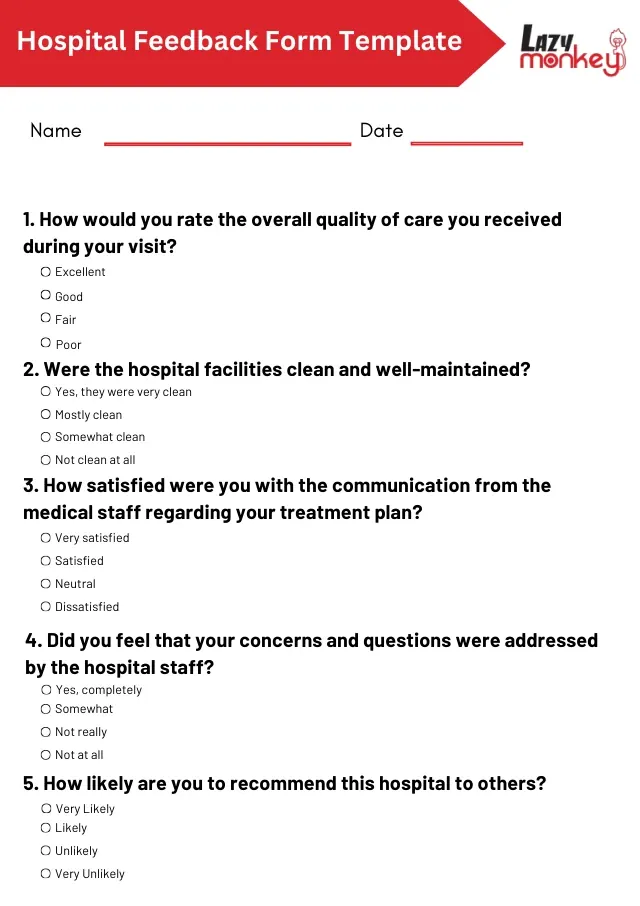
Example No. 2
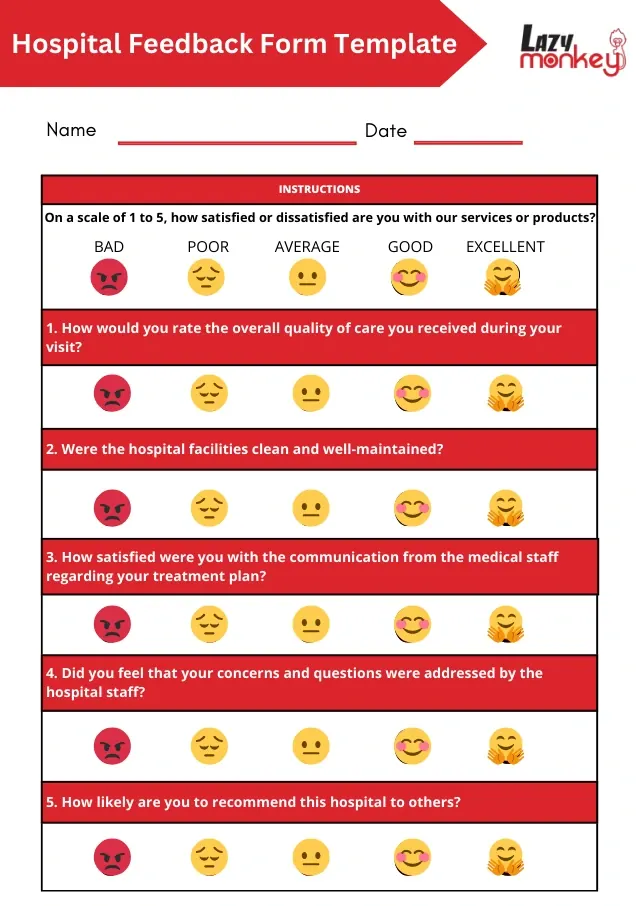
Key Elements of a Well-Designed Hospital Feedback Form
To create an effective hospital feedback form, consider incorporating the following elements:
1. Clear and Concise Questions
Ensure your questions are straightforward to understand. Avoid complex language or medical jargon that might confuse patients. For instance:
- Good: How satisfied are you with the cleanliness of your room?
- Poor: Was the overall sanitation of the room up to your standards?
2. Rating Scales
Use rating scales to quantify feedback. This approach helps in analyzing responses and identifying trends. Consider using a Likert scale (e.g., 1 to 5) to gauge satisfaction levels.
3. Open-Ended Questions
Include open-ended questions to capture detailed feedback. These allow patients to express their opinions and suggestions more freely. For example:
- What aspects of your visit could be improved?
- Do you have any additional comments or suggestions?
4. Specific Sections
Break the form into sections focusing on different aspects of the hospital experience, such as:
- Admission Process
- Patient Care
- Facilities and Cleanliness
- Discharge Process
How to Customize Your Hospital Feedback Form Template?
Customizing your hospital feedback form involves several steps to ensure it meets your needs and gathers valuable information.
1. Identify Your Objectives
Determine what you want to achieve with the feedback form. Are you looking to improve patient care, streamline processes, or enhance facility cleanliness? Your objectives will guide the questions you include.
2. Incorporate Relevant Questions
Based on your objectives, create questions that address specific areas. For example, if you’re focusing on patient care, ask about the attentiveness of staff and the quality of communication.
3. Use Patient-Centric Language
Make sure the language used in the form is patient-friendly. Avoid technical terms and frame questions in a way that is easy for patients to understand.
4. Test the Form
Before rolling out your feedback form, test it with a small group of patients or staff. Gather feedback on the clarity and effectiveness of the form and make necessary adjustments.
Best Practices for Effective Hospital Feedback Systems Forms
To maximize the effectiveness of your feedback form, follow these best practices:
1. Ensure Accessibility
Make the form accessible both online and offline. Provide paper forms in waiting areas and offer digital options for those who prefer to complete them online.
2. Keep it Short
Respect your patients’ time by keeping the form concise. Aim for a completion time of 5 to 10 minutes. Long forms can lead to incomplete responses or frustration.
3. Offer Incentives
Consider offering incentives to encourage participation. Small rewards, such as gift cards or discounts on services, can boost response rates.
4. Analyze and Act on Feedback
Regularly review the feedback you receive and use it to implement improvements. Share the results with your staff and make necessary changes to enhance patient satisfaction.
Sample Hospital Feedback Questions
The questions below can be added to the sections of your form. Pair each rating question with a short comment box so patients can explain the score they gave.
General Questions for Any Department
- How would you rate your overall experience? (1 to 5)
- How clearly did the doctors and nurses explain your condition and treatment?
- When you needed help, how quickly did staff respond?
- Did staff listen to your concerns?
- How satisfied were you with the time you waited to be seen?
- Did anything during your visit make you feel unsafe?
Questions for Specific Departments
Each department needs its own questions. A patient who had surgery should get a different set from someone who came in for a routine check-up.
Surgical department: focus on care before and after the operation, how the procedure was explained, pain management and follow-up. See the surgery feedback template for a full form.
- How well was the surgical procedure explained to you?
- Were your pain management needs adequately addressed?
- How satisfied were you with the follow-up care?
Maternity ward: focus on prenatal and postnatal care, support during labor, and the comfort and cleanliness of the ward. See the maternity ward feedback template.
- How well did the staff support you during labor?
- Were your postnatal care needs met?
- How satisfied were you with the breastfeeding support provided?
Hospital Feedback Comment Examples
Below are sample comments of three kinds that patients leave in the open-ended section of a form, with notes on how a hospital can use each.
Positive Feedback Examples
Positive comments highlight what went well, such as clear communication, compassionate care or a good treatment outcome. Share them with the team: they lift staff morale and show which practices to keep.
- “The doctor explained my diagnosis and treatment in simple words and answered all my questions.”
- “The nurses were kind and patient with my mother throughout her stay.”
- “My surgery went well, and the follow-up instructions were easy to understand.”
Constructive Feedback on Communication
These comments point to gaps such as unclear explanations, slow responses or staff not listening. Use them to guide staff training.
- “I would have liked a clearer explanation of my test results.”
- “Staff took a long time to respond when I asked for help.”
- “The doctor seemed rushed and did not listen to all my concerns.”
Negative Feedback on Long Wait Times
Complaints about delays are a common kind of negative feedback. Addressing them means improving patient flow and reducing waiting times.
- “I waited long past my appointment time, and no one told me about the delay.”
- “The queue at the registration counter moved too slowly.”
Conclusion
Customizing your hospital feedback systems form is essential for obtaining valuable insights and driving continuous improvement. By designing a form that addresses specific aspects of your hospital’s services, you can ensure more relevant and actionable feedback.
Implementing best practices, such as keeping the form accessible and concise, will further enhance its effectiveness.
Frequently Asked Questions
What Is A Hospital Feedback Systems Form?
A hospital feedback systems form is a tool used to gather patient opinions on various aspects of their hospital experience, such as care quality, facilities, and overall satisfaction.
How Can I Customize My Hospital Feedback Form?
Customize your form by identifying your objectives, incorporating relevant questions, using patient-friendly language, and testing the form before implementation.
Why Is It Important To Have Open-Ended Questions In The Feedback Form?
Open-ended questions allow patients to provide detailed feedback and suggestions, offering more insights beyond simple ratings.
How Can I Increase Response Rates For My Hospital Feedback Form?
Increase response rates by making the form accessible, keeping it short, offering incentives, and ensuring patients are aware of its importance.
How Do You Write Good Feedback for a Hospital?
Be specific about what happened: how clearly things were explained, how staff treated you, how long you waited and how your treatment went. Mention what went well as well as what could be better, so the hospital knows what to keep and what to fix.
Filed under Feedback Form Templates · First published