

In this article (13 sections)
- Why Patient Satisfaction Matter?
- Components of an Effective Patient Satisfaction Survey Template
- Designing Your Patient Satisfaction Survey Template
- Top Patient Satisfaction Survey Template Examples
- Best Practices for Patient Satisfaction Surveys
- Analyzing Survey Results
- Leveraging Technology for Surveys
- Examples of Patient Satisfaction Survey Questions
- Patient Satisfaction Survey Questions With Answer Options
- When and How Often To Run Patient Satisfaction Surveys
- Common Patient Survey Mistakes and How To Avoid Them
- Conclusion
- Frequently Asked Questions
Patient satisfaction is a key indicator of healthcare quality. Utilizing a well-structured patient satisfaction survey template can significantly improve patient care. This guide will delve into the essentials of crafting an effective survey, ensuring you gather insightful feedback to enhance healthcare services.
Why Patient Satisfaction Matter?
Patient satisfaction is more than just a metric; it reflects the quality of care provided. High patient satisfaction rates can lead to better patient retention, improved health outcomes, and a stronger reputation for healthcare providers. Satisfied patients are more likely to follow treatment plans and recommend the provider to others.
Here are some other related templates that you can check out: Hospital Patient Feedback Template
Components of an Effective Patient Satisfaction Survey Template
An effective patient satisfaction survey template should include several key components:
- Introduction: Explain the survey’s purpose and assure confidentiality.
- Demographic Information: Collect basic patient information to analyze trends.
- Service Quality: Assess various aspects of the care provided.
- Staff Interaction: Evaluate patient interactions with healthcare staff.
- Facility Feedback: Gather opinions on the healthcare facility’s environment.
- Overall Satisfaction: Measure overall patient satisfaction.
- Open-ended questions: Allow patients to provide detailed feedback.
Designing Your Patient Satisfaction Survey Template
Creating a patient satisfaction survey template involves careful planning. Each section should be crafted to elicit clear, actionable feedback.
1. Introduction and Purpose
Start with a brief introduction that explains the survey’s purpose. Assure patients that their responses are confidential and will be used to improve services. This builds trust and encourages honest feedback.
2. Collecting Demographic Information
Includes questions about the patient’s age, gender, and visit type. This helps in segmenting data and identifying trends. Demographic information can highlight specific areas needing attention based on patient groups.
3. Assessing Service Quality
Ask patients to rate the quality of various services they received, such as appointment scheduling, wait times, and the clarity of information provided. Use a Likert scale (e.g., 1-5) for consistency in responses.
4. Evaluating Staff Interaction
Patients’ interactions with healthcare staff significantly impact their overall experience. Include questions about the professionalism, empathy, and communication skills of doctors, nurses, and administrative staff.
5. Gathering Facility Feedback
The healthcare facility’s environment plays a crucial role in patient satisfaction. Ask about cleanliness, comfort, and accessibility. Patients’ feedback on the physical environment can lead to improvements that enhance their overall experience.
6. Measuring Overall Satisfaction
Include a section for overall satisfaction, asking patients to rate their overall experience. This provides a snapshot of how well the healthcare provider is performing.
7. Incorporating Open-Ended Questions
Allow patients to share additional comments or suggestions. Open-ended questions can reveal insights that structured questions might miss. Encourage detailed responses to gain a deeper understanding of patient needs and concerns.
Top Patient Satisfaction Survey Template Examples
Example.1
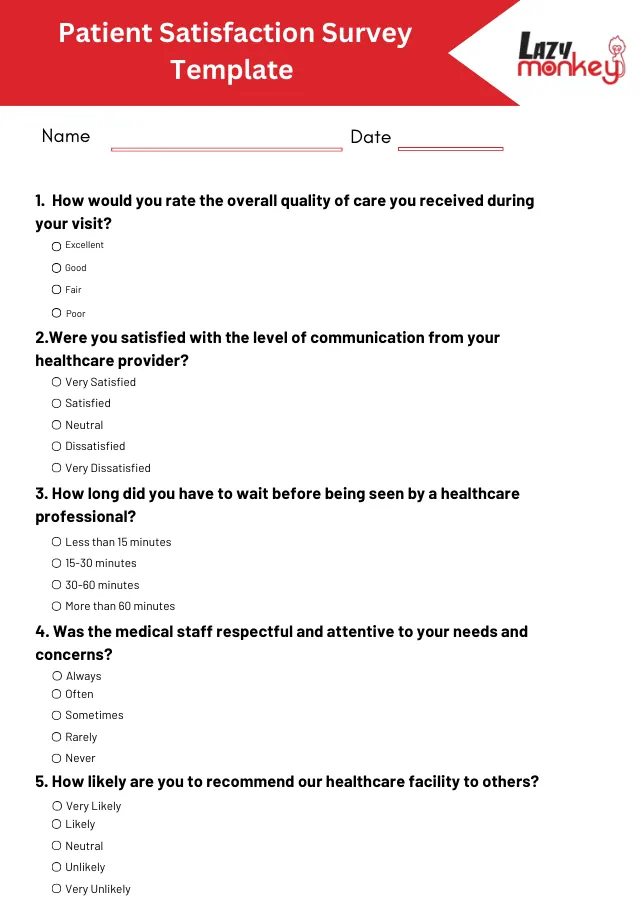
Example.2
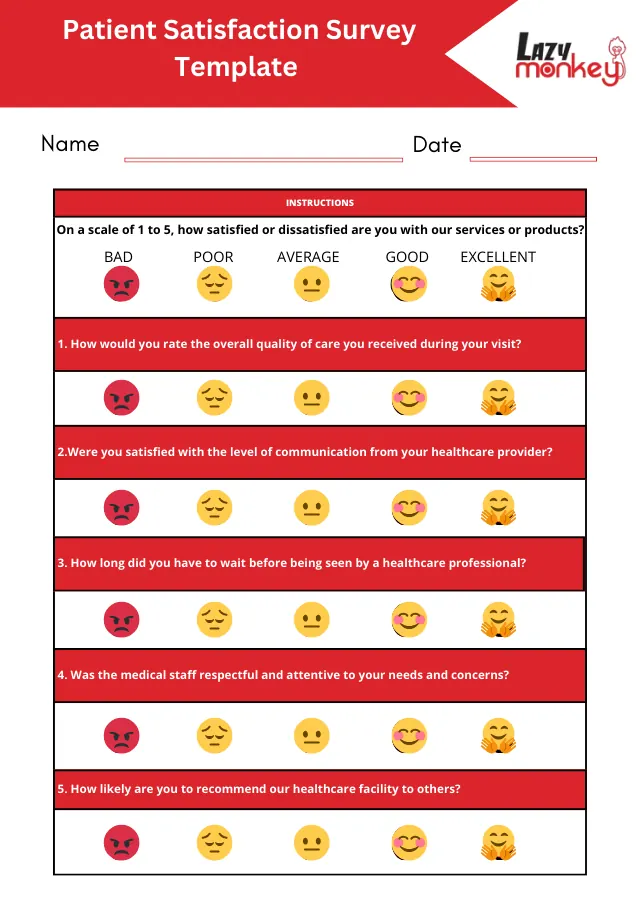
Best Practices for Patient Satisfaction Surveys
To ensure your patient satisfaction survey template is effective, follow these best practices:
1. Keep It Short and Focused
Patients are more likely to complete a survey if it’s brief and to the point. Aim for a survey that takes no more than 10-15 minutes to complete. Focus on the most critical aspects of patient care.
2. Use Simple Language
Ensure the survey is easy to understand by using simple, clear language. Avoid medical jargon and complex terms that could confuse patients.
3. Offer Multiple Response Options
Provide a variety of response options, such as multiple-choice, rating scales, and open-ended questions. This allows patients to express their opinions in different ways and provides richer data.
4. Ensure Anonymity and Confidentiality
Assure patients that their responses are anonymous and confidential. This encourages honest feedback and increases the reliability of the data collected.
5. Pilot Test Your Survey
Before full implementation, pilot-test your survey with a small group of patients. This helps identify any issues with question clarity or survey length and allows for adjustments before wider distribution.
6. Regularly Review and Update the Survey
Patient needs and expectations can change over time. Regularly review and update your survey to ensure it remains relevant and comprehensive. Incorporate new questions as necessary to address emerging trends.
Analyzing Survey Results
Collecting patient feedback is only the first step. Analyzing the results effectively is crucial for implementing meaningful changes.
1. Quantitative Analysis
Use statistical methods to analyze quantitative data from rating scales and multiple-choice questions. Look for patterns and trends in the responses to identify strengths and areas for improvement.
2. Qualitative Analysis
Analyze open-ended responses for recurring themes and insights. Qualitative data can provide a deeper understanding of patient experiences and highlight specific issues that need attention.
3. Benchmarking
Compare your results with industry benchmarks or previous survey results. This helps in measuring progress and setting realistic goals for improvement in patient satisfaction.
4. Creating Action Plans
Develop action plans based on the survey results. Prioritize areas needing immediate attention and allocate resources to implement changes. Communicate these plans to staff and patients to show that their feedback is valued and acted upon.
5. Monitoring Progress
Regularly monitor the impact of implemented changes. Use subsequent surveys to measure improvement and make further adjustments as necessary. Continuous monitoring ensures that patient satisfaction remains a priority.
Leveraging Technology for Surveys
Technology can streamline the survey process, making it easier to collect and analyze patient feedback.
1. Online Surveys
Online surveys are convenient for patients and can reach a wider audience. Using secure platforms like LazyMonkey can help protect patient data while ensuring ease of use.
2. Automated Reminders
Send automated reminders to patients to complete the survey. This can significantly increase response rates and ensure timely feedback collection.
3. Mobile-Friendly Surveys
Ensure your survey is mobile-friendly, as many patients may prefer to complete it on their smartphones. A responsive design improves accessibility and increases completion rates.
4. Real-Time Feedback
Implement systems for real-time feedback during patient visits. This allows immediate action on urgent issues and demonstrates a commitment to patient satisfaction.
Here are some other related templates that you can check out: Nurse Feedback Template
Examples of Patient Satisfaction Survey Questions
To create an effective patient satisfaction survey template, consider the following examples of questions:
- Introduction: We value your feedback. This survey will help us improve our services.
- Demographic Information: Please indicate your age group: 18-30, 31-45, 46-60, 60+.
- Service Quality: How would you rate the ease of scheduling your appointment?
- Staff Interaction: Were the healthcare staff professional and courteous?
- Facility Feedback: How satisfied were you with the cleanliness of our facility?
- Overall Satisfaction: How would you rate your overall experience with our healthcare services?
- Open-Ended Questions: Please share any additional comments or suggestions.
Patient Satisfaction Survey Questions With Answer Options
The examples above give one question per section. The question bank below goes further, grouped by stage of care, with answer options you can copy into your template. Choose the questions that fit your service: an outpatient clinic can leave out the admission, hospital stay and discharge rows, while an inpatient survey should keep them.
Answer Scales for Patient Satisfaction Surveys
Each scale has five points, matching the 1-5 Likert scale described above. Using the same few scales throughout keeps responses consistent and easy to compare.
| Scale | Answer options (lowest to highest) | Use it for |
|---|---|---|
| Satisfaction | Very dissatisfied, Dissatisfied, Neutral, Satisfied, Very satisfied | Wait times, communication, billing |
| Quality | Very poor, Poor, Average, Good, Excellent | Overall care, staff responsiveness, nursing attentiveness, food |
| Extent | Not at all, Slightly, Moderately, Very much, Completely | Explanations, involvement in decisions, time spent with you, privacy |
| Ease | Very difficult, Difficult, Neutral, Easy, Very easy | Admission, understanding instructions |
| Handling | Very poorly, Poorly, Neutral, Well, Very well | Pain management, complaint handling |
| Likelihood | Very unlikely, Unlikely, Neutral, Likely, Very likely | Recommending the hospital |
Sample Questions by Stage of Care
| Area | Question | Answer options |
|---|---|---|
| Admission (inpatients) | How easy was your admission process? | Ease |
| Admission (inpatients) | Was the information given during admission clear and easy to understand? | Extent |
| Waiting | How long did it take before the doctor attended to you? | Just as I expected / Longer than I wished for |
| Waiting | How satisfied were you with the wait time in the waiting area? | Satisfaction |
| Communication | How satisfied were you with how your doctors and nurses communicated with you? | Satisfaction |
| Communication | How well did the doctors explain your condition and treatment options? | Extent |
| Care | Did you feel involved in decisions about your treatment? | Extent |
| Care | Did you feel the doctors spent enough time with you? | Extent |
| Care | How well were your pain and symptoms managed? | Handling |
| Care | How would you rate the overall quality of care you received? | Quality |
| Staff | Did our staff show empathy towards your needs? | Not empathetic / Somewhat empathetic / Empathetic / Extremely empathetic |
| Staff | How would you rate the staff's responsiveness to your requests or concerns? | Quality |
| Staff | How would you rate the attentiveness of the nursing staff? | Quality |
| Staff | How well did the staff handle any complaints or concerns you had? | Handling |
| Hospital stay (inpatients) | How would you rate the quality of the food provided? | Quality |
| Hospital stay (inpatients) | Were noise levels in the hospital low enough for you to rest? | Yes / No |
| Hospital stay (inpatients) | Did you feel safe during your stay? | Yes / No |
| Hospital stay (inpatients) | Were your privacy and confidentiality respected? | Extent |
| Discharge | How easy were your discharge instructions to understand? | Ease |
| Discharge | Did you feel prepared to continue your care at home? | Extent |
| Discharge | Was the follow-up care process explained to you clearly? | Yes / No |
| Billing | How satisfied were you with the billing and payment process? | Satisfaction |
| Loyalty | How likely are you to recommend our hospital to family or friends? | Likelihood |
| Open-ended | What aspects of your visit were most satisfactory? | Free text |
| Open-ended | Can you describe any difficulties you experienced during your visit or stay? | Free text |
For a full set of discharge questions, see our discharge process feedback template.
When and How Often To Run Patient Satisfaction Surveys
There is no single right frequency; it depends on your goals and patient volume. Common approaches are:
- After every visit or discharge: Gives continuous, timely feedback and is the recommended approach for inpatient surveys.
- At set intervals: For example quarterly or annually.
- After major service changes: Gathers timely feedback on what has changed.
Surveying too rarely means missing feedback while problems can still be fixed. Asking the same patients to fill in several surveys in a short period causes survey fatigue.
Inpatient Experience Surveys
An inpatient experience survey covers the whole hospital stay: admission, care and treatment, the hospital environment (cleanliness, noise, comfort, food and safety), discharge and overall satisfaction. Send it shortly after discharge, so the experience is still fresh but the patient has had time to recover. Automated follow-up surveys can be customized to the patient's treatment.
Real-Time Feedback During the Stay
A post-discharge survey describes the whole stay, but only after the patient has left. Collecting feedback during the stay, on smartphones, tablets or kiosks, lets staff fix problems while the patient is still in the hospital. The two complement each other: real-time feedback does not replace a full survey, including standardized ones such as the US HCAHPS (Hospital Consumer Assessment of Healthcare Providers and Systems) survey. Review real-time feedback daily or weekly, and make a dedicated team responsible for monitoring and responding to it.
With a QR-code system such as LazyMonkey's hospital patient feedback system, patients answer by scanning a code with their own phone, with no app to install, and issues are escalated to the right person.
Making Surveys Easy To Complete
- Offer more than one format, such as online, on paper and through the patient portal, and more than one language.
- Make sure the survey can be completed regardless of literacy level or disability.
- Tell patients why their feedback matters and how it will be used. This transparency increases response rates.
- Brief staff on the survey's purpose so they encourage patients to take part.
Common Patient Survey Mistakes and How To Avoid Them
| Mistake | Why it is a problem | How to avoid it |
|---|---|---|
| Vague questions | "Were you satisfied with your visit?" is too broad to act on | Ask about one specific area, such as "How would you rate the cleanliness of the examination room?" |
| Leading questions | Wording that suggests an answer produces biased results | Use neutral wording |
| Response bias | Patients may hold back criticism for fear it will affect their future care, or rate too positively out of gratitude | Keep the survey anonymous, say so clearly and ask neutral questions |
| Low response rates | Results become skewed and less representative of your patient population | Use several distribution channels and remind patients why their feedback matters |
| Survey fatigue | Patients asked to fill in several surveys in a short period give less thoughtful answers or stop responding | Avoid sending the same patient several surveys in a short period |
| Ignoring open-ended answers | Comments take time to analyze, so they are often skipped and their insights lost | Code comments into categories and look for recurring themes |
Conclusion
Creating a comprehensive patient satisfaction survey template is essential for healthcare providers aiming to improve patient care. By carefully designing the survey, following best practices, and leveraging technology, you can gather valuable feedback that drives continuous improvement.
Remember, patient satisfaction is not just a metric but a vital component of quality healthcare.
Frequently Asked Questions
What Is A Patient Satisfaction Survey Template?
A patient satisfaction survey template is a structured tool used by healthcare providers to gather feedback from patients about their experiences and satisfaction with the services received.
Why Is Patient Satisfaction Important In Healthcare?
Patient satisfaction is crucial as it reflects the quality of care provided, impacts patient retention, and influences health outcomes. Satisfied patients are more likely to adhere to treatment plans and recommend the provider.
How Can I Ensure High Response Rates For My Patient Satisfaction Survey?
To ensure high response rates, keep the survey short and focused, use simple language, assure confidentiality, and send automated reminders to patients.
What Types Of Questions Should Be Included In A Patient Satisfaction Survey?
Include questions about service quality, staff interaction, facility feedback, overall satisfaction, and open-ended questions for detailed feedback.
How Often Should Patient Satisfaction Surveys Be Conducted?
It depends on your goals and patient volume. Many providers survey after every visit or discharge, while others run surveys at set intervals, such as quarterly, or after major service changes.
What Is An Inpatient Experience Survey?
It is a questionnaire for patients who stayed in hospital, covering the admission process, quality of care, hospital environment, discharge and overall satisfaction. It is best sent shortly after discharge.
Are Patient Satisfaction Surveys Anonymous?
Most are, because patients give more honest feedback when they know their responses are anonymous and confidential. Say so clearly at the start of the survey.
Filed under Feedback Form Templates · First published